View
Abstract
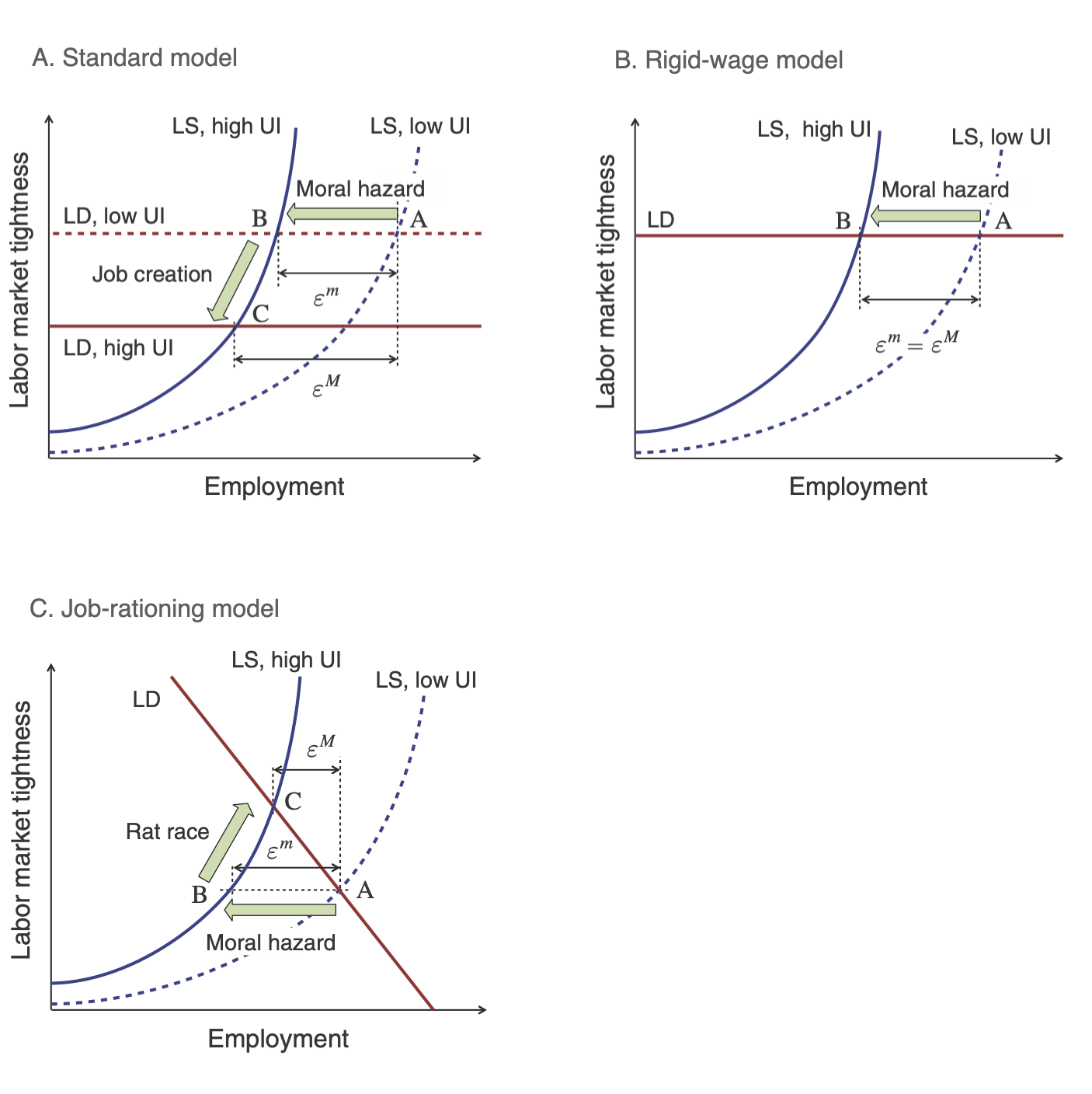
This paper develops a theory of optimal unemployment insurance (UI) in matching models. The optimal UI replacement rate is the conventional Baily-Chetty replacement rate, which solves the tradeoff between insurance and job-search incentives, plus a correction term, which is positive when an increase in UI pushes the labor market tightness toward its efficient level. In matching models, most wage mechanisms do not ensure efficiency, so tightness is generally inefficient. The effect of UI on tightness depends on the model: increasing UI may raise tightness by alleviating the rat race for jobs or lower tightness by increasing wages through bargaining.
Figure 4: Effect of UI on labor market tightness in different matching models
Citation
Landais, Camille, Pascal Michaillat, and Emmanuel Saez. 2018. “A Macroeconomic Approach to Optimal Unemployment Insurance: Theory.” American Economic Journal: Economic Policy 10 (2): 152–181. https://doi.org/10.1257/pol.20150088 .
@article{LMS18,
author = {Camille Landais and Pascal Michaillat and Emmanuel Saez},
year = {2018},
title = {A Macroeconomic Approach to Optimal Unemployment Insurance: Theory},
journal = {American Economic Journal: Economic Policy},
volume = {10},
number = {2},
pages = {152--181},
url = {https://doi.org/10.1257/pol.20150088}}
Related material
- Presentation slides
- Companion paper – The companion paper applies the theory from this paper to determine how the generosity of unemployment insurance should vary over the business cycle in the United States. It finds that the optimal US unemployment insurance is countercyclical (more generous in bad times), just like the actual US unemployment insurance.